

Every wheel strategy guide on the internet tells you the same thing: "sell Puts on quality stocks you wouldn't mind owning."
This is well-intentioned advice. But it is also dangerously incomplete.
"Quality" is not a screener filter, and "wouldn't mind owning" is not a risk management framework. If you had applied this logic to Silicon Valley Bank in early 2023 — a profitable, dividend-paying, widely-held bank stock — you would have watched your "quality" holding drop 97% in 48 hours.
Investors who avoid these traps don't rely on gut instinct — they calculate. Before selling a single Put, they already know the stock's fair value, know their margin of safety, and can confirm with mathematical confidence: if assigned shares, they are buying at a discount, not walking into a value trap.
This is the wheel strategy that most guides don't teach.
Since 2022, SlashTraders has been running a math-based wheel and options income system on a fully transparent $2.5M live portfolio — every trade publicly logged, every loss clearly visible, and every return verified by API in real time. This guide will walk you through the complete method we use, including our stock screening tools and real-world examples.
What Is the Wheel Strategy?
The wheel strategy is a two-phase options income cycle built on two core strategies: the Cash-Secured Put and the Covered Call.
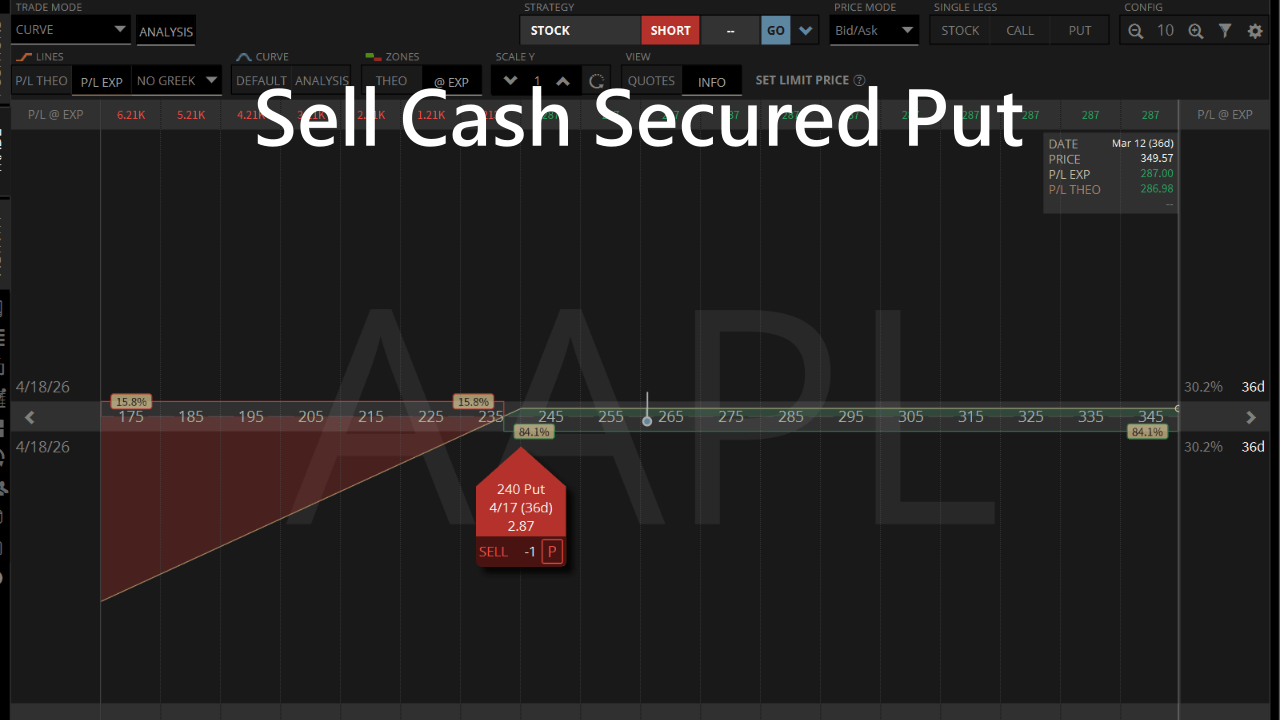
Phase 1 — Sell a Cash-Secured Put
You sell a Put on a stock you genuinely want to own, collecting a premium upfront. In exchange, you take on the obligation to buy 100 shares at the strike price if the stock price falls to that level before expiration.
- If the stock stays above the strike price: the Put expires worthless, you keep 100% of the premium, and repeat phase 1.
- If the stock falls to or below the strike price: you buy 100 shares at the strike price and move to phase 2.
Phase 2 — Sell a Covered Call
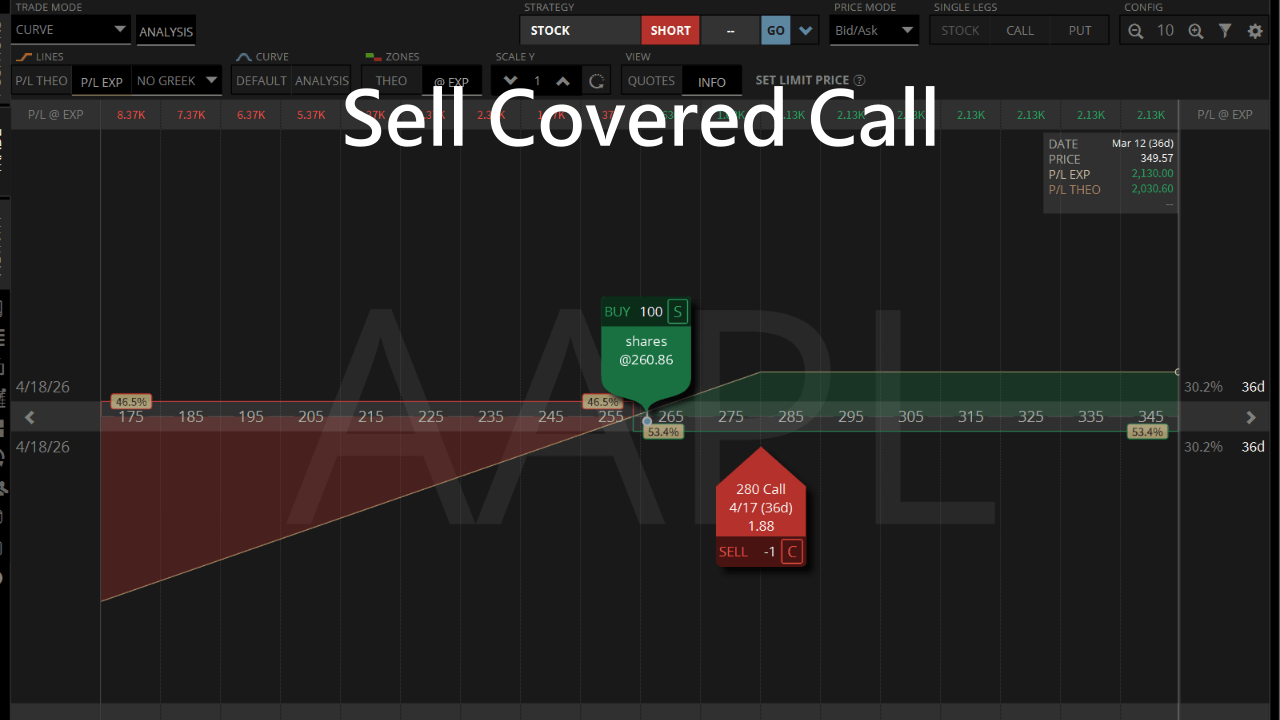
Now that you own 100 shares, you sell a Call against those shares and collect another premium.
- If the stock stays below the strike price: the Call expires worthless, you keep the premium and your shares, and repeat phase 2.
- If the stock rises to or above the strike price: shares are "called away" at the strike price, and you return to phase 1.
That's the wheel. Mechanically very simple — the complexity, and the edge, lies entirely in stock selection.
Why Value Investing Is the Key Most Wheel Strategies Are Missing
When you choose a stock to sell a Put, you are effectively agreeing to buy a stock at a specific price. This means your stock selection decision is not about abstract "quality" — it's about whether that specific price represents good value. And that is a calculation, not a feeling.
Danger of Being Assigned an Overvalued Stock
Imagine you're running the wheel on a stock trading at $80. Analysts love it, it pays a dividend, it's in the S&P 500. You sell the $75 Put and collect a $3 premium. The stock drops to $72 and you're assigned with a cost basis of $72.
But what if that stock's fair value — calculated based on actual earnings, growth rate, and historical valuation multiples — is $55?
You haven't bought a discount. You've bought into a stock that still has 24% more downside to go. The wheel strategy cannot protect you from this — only a fair value calculation can.
Structural Advantage of Value Investors
By combining value investing with the wheel strategy, you have already secured three layers of discount before any potential assignment, forming your margin of safety:
- Buying below fair value.
- Buying at a strike price below the current stock price.
- Further reducing your cost basis through the premium received.
If you are forced to buy a genuinely undervalued stock, you are not in trouble — you are in an excellent long-term position, collecting Covered Call income while waiting for the market to recognize the stock's true value. If the stock is never assigned, you are simply collecting premiums on an undervalued stock that keeps rising — also an outstanding outcome.
How SlashTraders Calculate Fair Value
Our algorithm calculates fair value using normalised earnings, sector-adjusted P/E multiples, dividend-adjusted yield, and projected growth rates, then compares it to the current price to derive the upside percentage — updated daily in the Bullish Value Stock screener. A stock with an upside of +25% is trading 25% below its mathematically calculated fair value.

SlashTraders Five-Step Wheel Setup
Using the SlashTraders proprietary stock screening tools, the entire process from screening to executing the wheel strategy takes less than 10 minutes.
Step 1 — Find a Fundamentally Undervalued Stock
Open the Bullish Value Stocks list, sort by upside, and look for:
- Upside of 15% or more — a meaningful margin of safety.
- A stable dividend history — not required, but a high yield can boost returns when selling Covered Calls.
Step 2 — Confirm Implied Volatility Is Elevated (But Not at Panicking Levels)
You want implied volatility to be higher — a stock with an IV Rank of 60 will give you roughly double the premium of the same stock at IV Rank of 20. But extreme implied volatility (IV Rank above 80–90) usually signals a genuine crisis. Use the Options Scanner to check IV Rank — target range is IV Rank 40–70.
| Symbol | Last | Fair Value | Upside | Dividend Yield | IV | IV Rank |
|---|---|---|---|---|---|---|
| MATW | $26.14 | $38 | 45.37% | 3.90% | 43.5% | 30.4% |
| EW | $84.61 | $99 | 17.01% | 0% | 31.0% | 42.0% |
| DOC | $17.50 | $19 | 8.57% | 7.01% | 43.3% | 70.5% |
| YORW | $31.73 | $34 | 7.15% | 2.88% | 221.9% | 18.0% |
Step 3 — Select Your Strike Price and Expiration
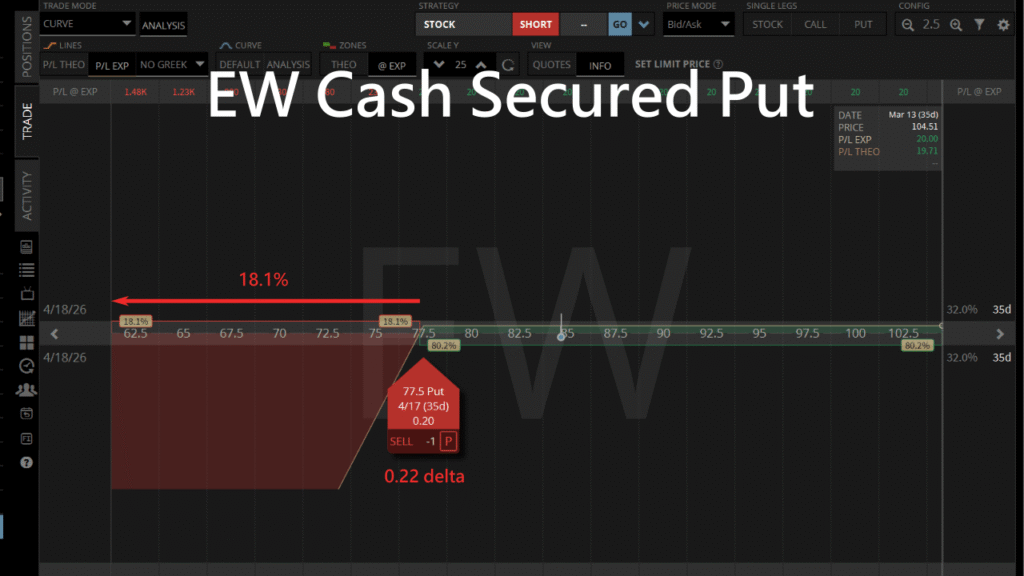
Strike price: target a Put delta of 0.20–0.30, corresponding to a strike roughly 8–15% below the current stock price, with approximately an 18% probability of being assigned.
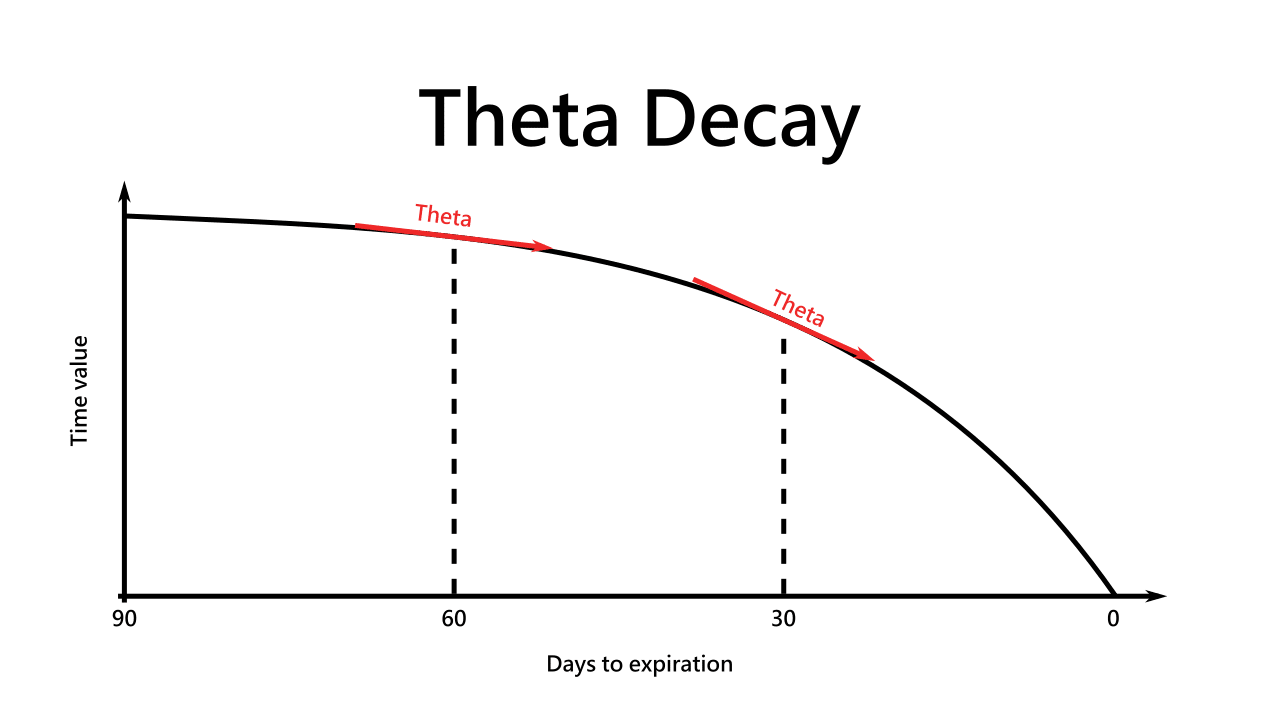
Expiration: target 30–45 days to expiration (DTE) — this is the sweet spot where theta decay accelerates.
Step 4 — Manage the Trade
As expiration approaches day by day, here are some trade management tips to respond to stock price movements:
- Stock price stays above the strike price: let it expire and keep the full premium, return to step 1.
- Stock price approaches the strike price before expiration (10–14 days remaining): if the fundamental thesis still holds, consider rolling — re-entering at a lower strike with a later expiration.
- Stock price drops sharply due to financial losses: redo the fundamental analysis and recalculate fair value before rolling.
- Assigned: proceed to step 5.
Step 5 — Sell a Covered Call
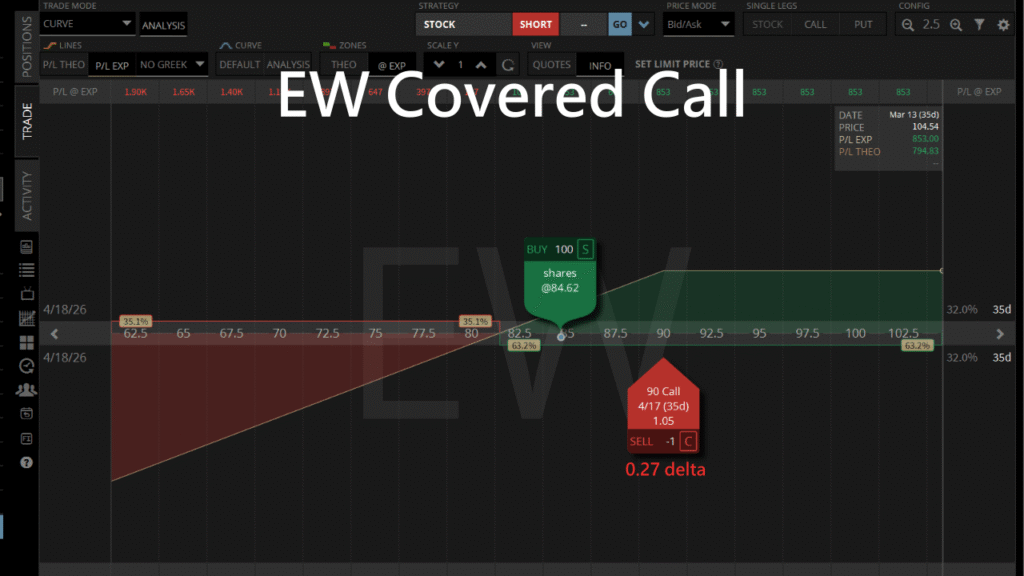
Your actual cost basis: strike price minus premium received. If you sold the $77.50 Put for $0.2, your cost basis is $77.30. If fair value is $99, you hold a stock "worth" $99 at a cost of $77.30 — a 22% margin of safety established before you sell your first Cash-Secured Put.
Continue selling Covered Calls using the same framework (delta 0.20–0.30, 30–45 DTE) until your shares are called away at a profit.
Risks of the Wheel Strategy
The greatest risk of the wheel strategy is when a stock drops significantly below the strike price. In that case, two management rules help minimise losses:
- Reassess the thesis, not the chart. After a 20%+ drop, recalculate fair value with updated earnings projections. If still significantly undervalued, hold and continue selling Cash-Secured Puts. If the business has deteriorated, exit and take the loss — a strategic loss is far better than a hope-driven hold.
- Never over-concentrate. Keep each position to 2–5% of the portfolio — even a 50% loss in a single stock will only impact the overall portfolio by 1–2.5%.
Wheel Strategy vs Simply Buying the Stock
For value investors, the core insight is: if you were going to hold this stock anyway, the wheel strategy is purely additive. You collect premium income while waiting for the stock price to revert to its fair value.
| Market condition | Buy and hold | Wheel strategy | Reason |
|---|---|---|---|
| Strong bull market | Slightly better | Good but capped | Covered Calls limit gains during sharp rallies |
| Flat/sideways market | Minimal returns | Strong returns | Premium income exceeds price gains |
| Modest decline | Unrealised loss | Smaller unrealised loss | Lower cost basis from premiums |
| Market crash | Large unrealised loss | Large unrealised loss | Lower cost basis from premiums |
| Post-crash recovery | Full recovery | Full recovery + premium | Premium collected increases gains |
Five Common Mistakes Wheel Traders Make
- Mistake #1: running the wheel on overvalued stocks — before looking at the options chain, first use the Dividend Screener to confirm your margin of safety.
- Mistake #2: chasing extreme implied volatility without checking fundamentals — a company-specific high IV Rank is usually a warning of a business crisis, not free premium. Always understand why IV is elevated before selling.
- Mistake #3: oversizing positions — a single Cash-Secured Put should not exceed 5% of the total portfolio. The wheel's edge comes from profiting consistently across many trades over many years, not from one big bet.
- Mistake #4: ignoring the earnings calendar — inflated premiums before earnings are compensation for the risk of a 15% single-day move, not free money. If earnings fall within your expiration window, shorten the expiration or skip the trade.
- Mistake #5: mechanically rolling without reassessing the fundamentals — before rolling, ask: is the stock still undervalued? If yes, roll. If not, exit. Rolling should be based on an updated fair value calculation, not on hope.
Simply understand the four characteristics of stocks suited for wheel trading — trading below fair value, stable or growing earnings, good options liquidity, and moderately elevated implied volatility — and you can confidently start using the wheel strategy to enhance long-term investment returns.
SlashTraders vs S&P 500: 450% Outperformance, Verified Trades and How to Copy Every Alert
請問最少需要多少美金才適合使用這策略呢?
需要購買100股的資金才能有效的執行滾輪投資