

Do you often hear about options from experienced investors?
You may have heard that options trading systems have higher leverage, and can make 5 to 10 times return on investment in a single trade. But you can lose everything if you are wrong about the market direction?
Today we start with the basics of options trading, and use profit analysis charts to show the differences in leverage. So you can quickly learn about options.
Contents
What Are Options?
An option is a right to trade stocks at a given strike price before a given date.
These are the key components of an option contract:
- Put option - the right to sell stocks
- Call option - the right to buy stocks
- Strike price - the agreed price to trade stocks
- Expiration - the deadline to exercise the right of the option
- An option contract in the US stock market is 100 stocks
If you own an option, you can sell (Put) or buy (Call) 100 shares at the strike price before expiration.
Profit Analysis of Trading Stocks
Let's start by revisiting the profit analysis of stock trading, o you get a better understanding of the leverage of trading options.
The market price of AAPL is $125 right now. Buying stocks is simply using $125 cash in exchange for a share. You make a profit when the price rises and lose money when the price falls.
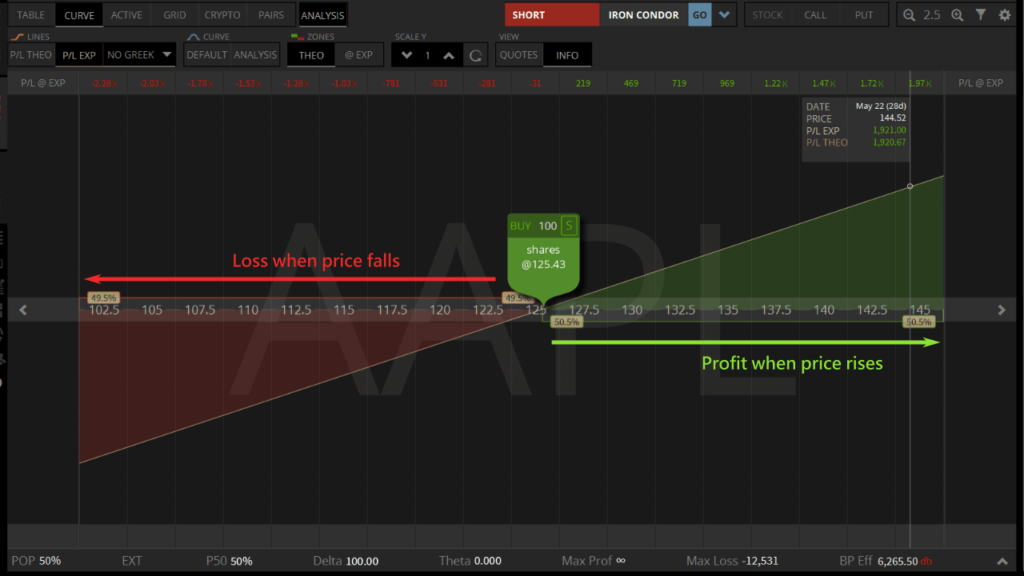
If you believe AAPL price will fall soon, you can short the AAPL to make money when the stock price falls. But you'll lose money if the price rises instead.
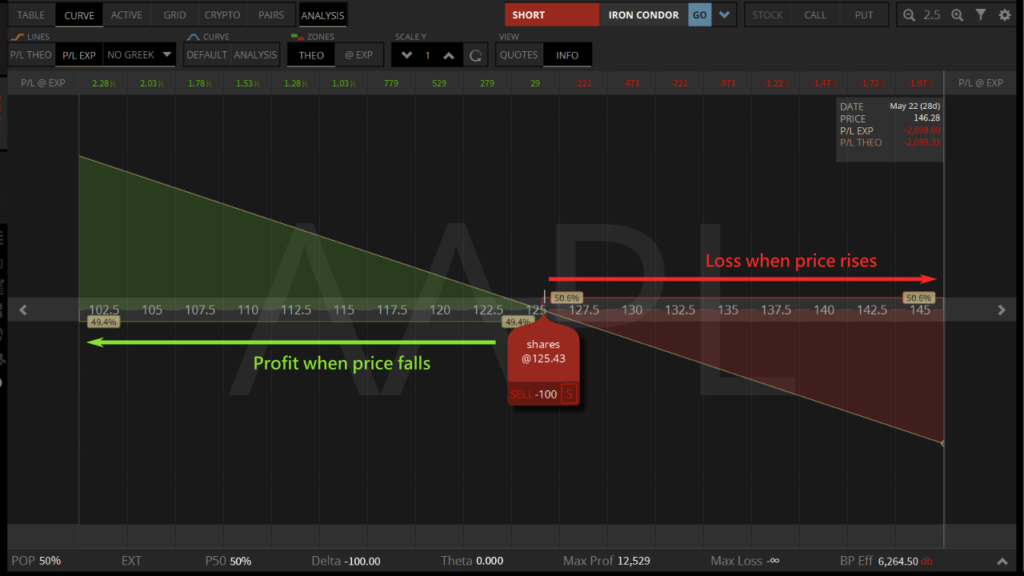
No matter you long or short stocks, the probability of profit is 50%. As long as you hold the position and Apple stays in business, the stocks you own stay valuable.
What Is a Put Option?
A Put option is a right to sell 100 shares at the strike price before expiration.
Looking at the AAPL price now, if we long a Put option at $120 that expires next month, it costs us $1.58 per share for this Put option contract. Since each contract is 100 shares, we spend $158 in total.
The profit analysis of a long Put is similar to shorting stocks. If the stock price falls below $120 before expiration, you can buy cheap AAPL stocks from the market, then exercise the Put option to sell the stocks to the Put seller for $120 and pocket the difference.
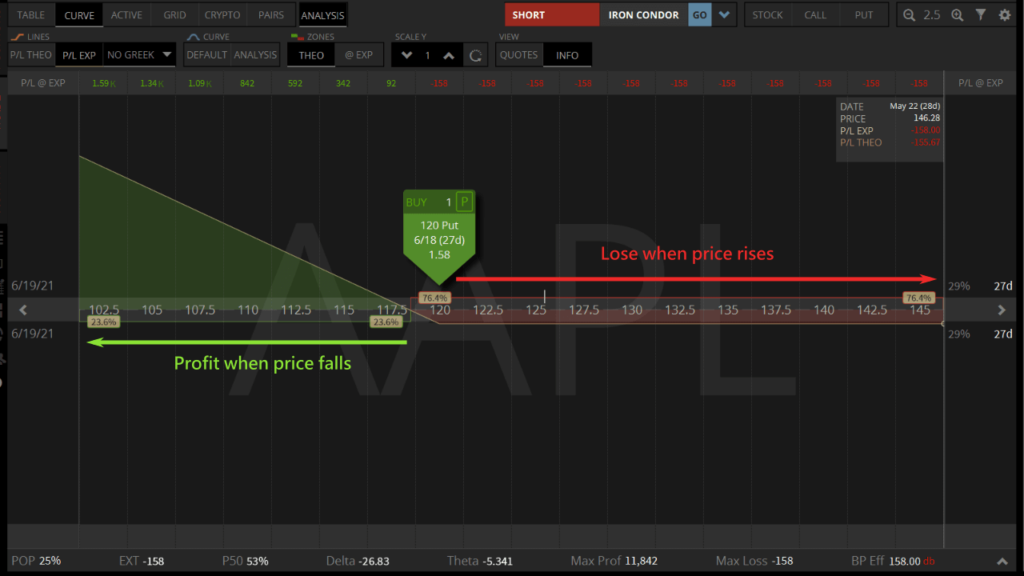
But if the stock remains above $120, the option expires worthless and you lose $158.
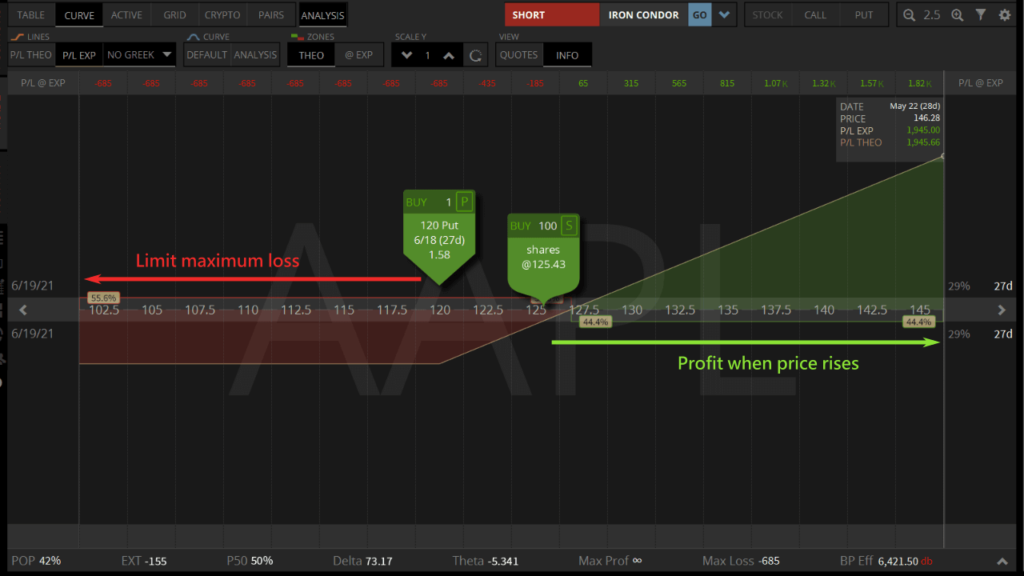
If we combine the profit analysis of long Put and long stocks, you can see the protective Put option is insurance against a market crash. The long Put limits your maximum loss by giving you an opportunity to sell 100 stocks at the strike price, no matter how far the market falls.
What Is a Call Option?
A Call option is a right to buy 100 shares at the strike price before expiration.
Looking at the AAPL price now, if we long a Call option at $130 that expires next month, it costs us $1.55 per share for this Call option contract. Since each contract is 100 shares, we spend $155 in total for this trade.
The profit analysis of a long Call is similar to a long stock position. If the stock price rises past $130 before expiration, you can exercise the Call option to buy 100 AAPL stocks at $130, then sell them at the market price for profit.

But if the stock price remains below $130, the option expires worthless and you lose $155.
If we combine the profit analysis of long Call and short stock, the Call option is insurance against the market boom. You can use long Call to limit the exposure to your short stock position when the price goes up by buying 100 shares at the strike price.
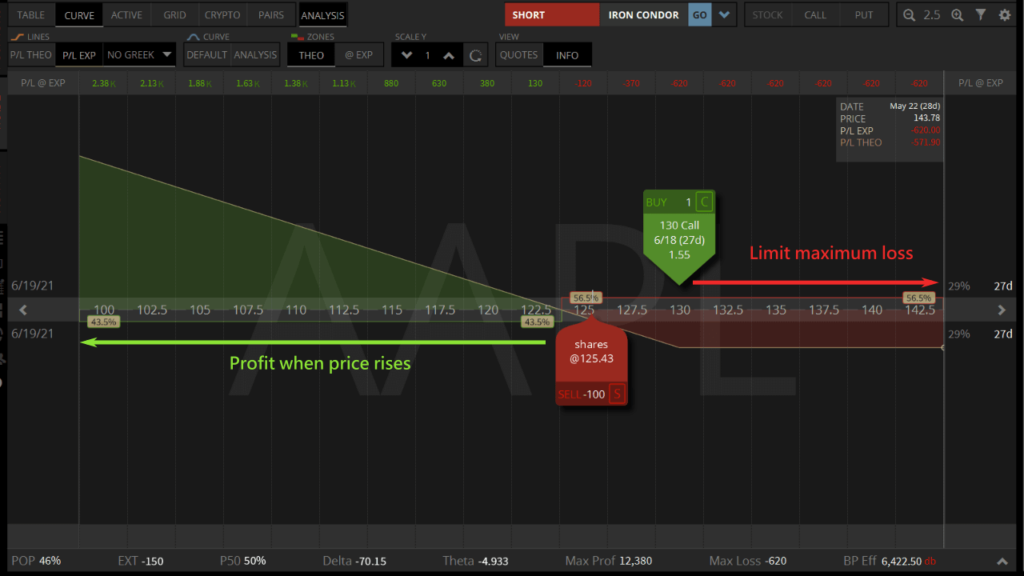

Differences in Leverage Between Options and Stocks
Since long Call is similar to long stock position, we can use profit analysis to look at the differences in leverage.
If you have $155 to invest, you can either long 1 stock of AAPL using $125, or spend $155 to long a Call option at $130 that expires next month.
If AAPL rises to $140:
- A long stock position makes $15 in profit or 12% return
- A long Call position makes $845 or 545% return

If the stock price remains below $130 one month later, the value of the long Call option becomes $0 (lose 100%).
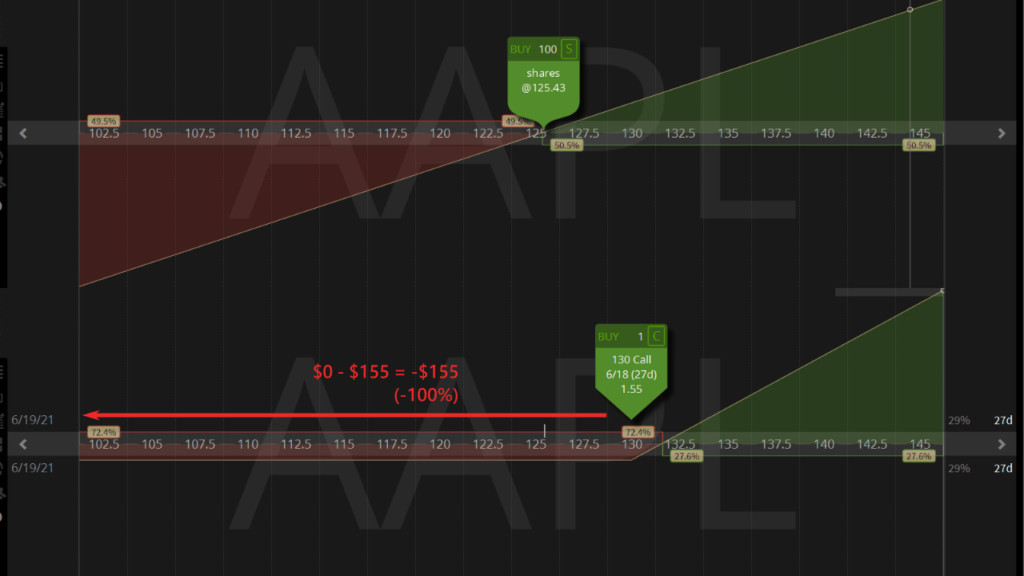
If the market goes up according to plan, the leverage on options can make 5 to 10 times per trade.
But if we are wrong about the market, while the stock position drops in value, the option expires worthless.
Best Bullish Options Trade Right Now
The Bull Put Spread Screener uses historical chart analysis to find bottom out stocks that have a high probability of an upward correction that we can sell Bull Put Spreads to profit from the dip.
We want to find heavily undervalued, bottomed out underlying that have a high probability of going up.
- Long Days indicates the number of trading days since the most recent bullish signal, based on technical analysis. A small number means we can enter the trade at the start of the bullish trend.
- Long Signal Price shows the recent dip based on technical analysis. We can be confident the stock price will not fall below this price level in the short term.
- The fundamental analysis shows us the Fair Value of the underlying. Then it compares with the Last value to find the potential Upside. The higher the Upside, the greater the confidence of the stock being undervalued.
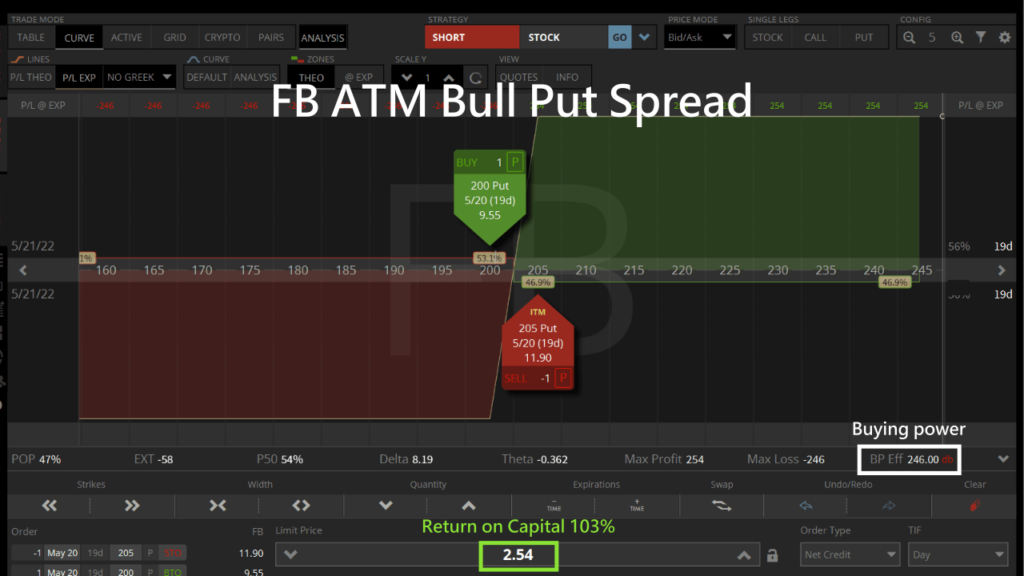
We can combine the 3 bullish signals in the screener to execute high probability bullish trades. The screener also helps us find high Return on Capital 0.50 delta ATM Bull Put Spreads.
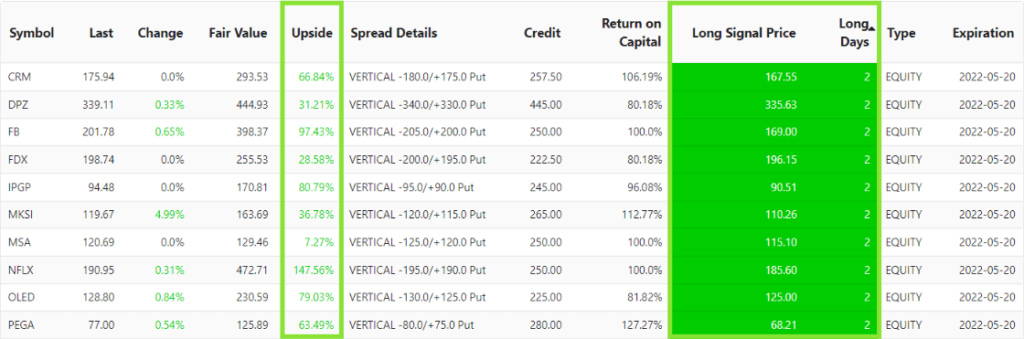
Then we can use the Spread Details to find the ATM Bull Put Spreads with the respective Return on Capital.
Let's pick the highest probability and high return Bull Put Vertical Spread entry points.
By combining Long Days and Upside, out of all bullish stocks that started within 2 trading days, FB is extremely undervalued with 97% upside. So it has a high probability of a bullish trend.
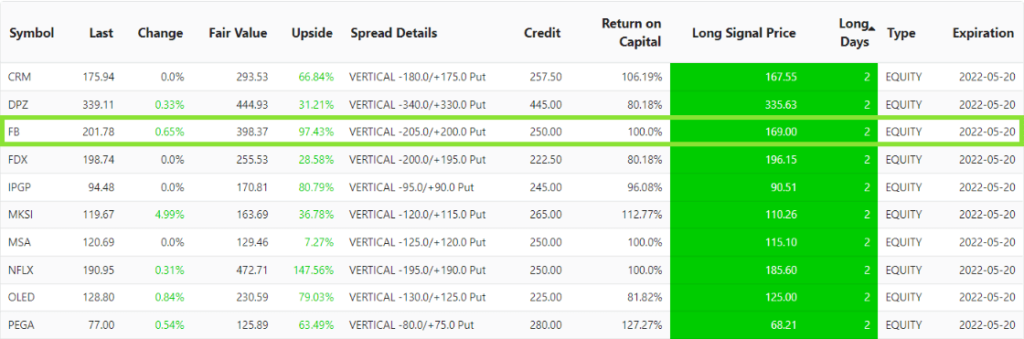
The FB price chart shows it reached a low point at Long Signal Price of $169 2 trading days ago, and has been bullish ever since.
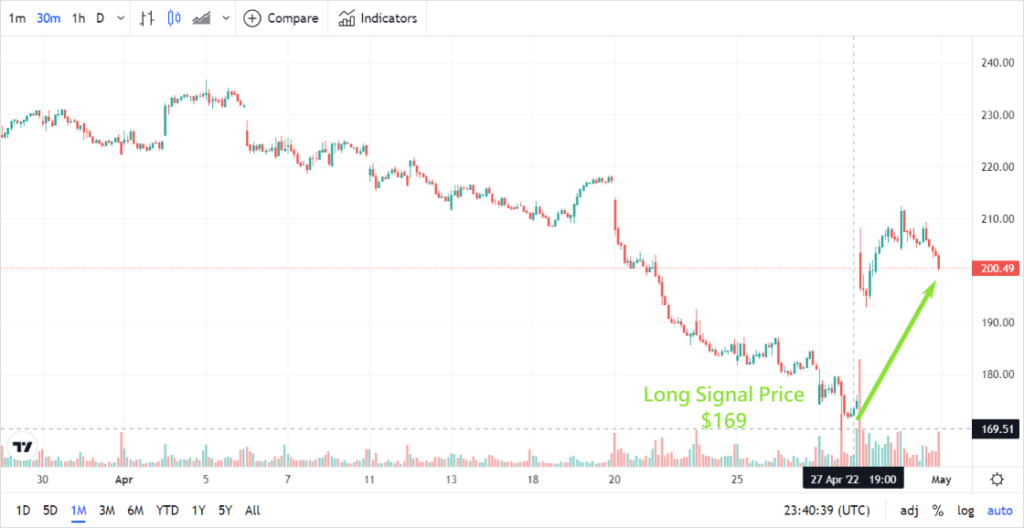
Considering FB is heavily undervalued, we can be confident of a bullish outlook.
We can sell a FB Bull Put Spread option that expires next month. If the Meta stock price does not fall before expiration, we can profit 103% from the trade.
Unbox the SlashTraders Strategies That Outperform the S&P 500 by 450%
Hello, I would like to ask if I buy a call option and the current stock price is > Strike price, can I, as the owner of the power, execute the power directly before the deadline? Usually the power can be exercised directly through the broker's APP or do I need to write a letter and send an email to the broker? (I'm using Firstrade) I'd be grateful if you could answer this question.
If the stock price > strike price after buying a call option, it is in-the-money.
(Price - strike price) x 100 - Call cost = Profit
This time you can:
1. If you have enough cash (Call strike price x 100) and want to hold the stock for a long period of time, you can do it directly through the broker's app and buy 100 shares with strike price, and the 100 shares you hold will increase in value to the stock price x 100.
2. If you don't have enough cash, you can Sell to Close, that is, sell a Call at the same price and on the same cut-off date to close out your position, and you can make a profit directly without purchasing the stock.
It's rare to see such a professional website on US stock options, I've learned a lot about options, thanks!
Thank you for your support.
Thanks to the moderator for such a complete tutorial on Put and Call options.
You're welcome.
Today, I finally figured out that options are investment tools for hedging.
Thank you for sharing.
Yes, knowing more about options gives you one more investment strategy to work with and find the one that suits you best.
Thank you for making options so much easier to understand.
Thank you for your kind words.
This is the best options tutorial I've seen on the internet, thank you!
Thank you for your support.
Thanks for sharing, it's a great tutorial for newbies like me on US stock options.
I'm glad the article was helpful, and please let us know if you have any other options-related questions!
Thank you very much for this beautiful informative article. This is very helpful & praiseworthy. I have learned many things from the article. other I have learned many things from the article. other traders included newbie traders will be helpful. great job. i appreciate your writing skills.
Glad you enjoyed this article.